
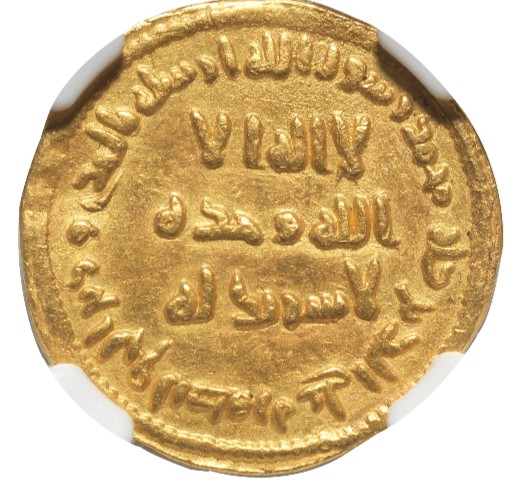
This image shows the Umayyad Gold Dinar from the year 77 AH (697 CE).
As mentioned, it is purely epigraphic, featuring the central declaration: “There is no god but Allah, the One, He has no associate.” Around the margin, the text typically identifies the year and location of the mint. This specific coin design remained the standard for Islamic gold currency for centuries.
The coinage of the Umayyad Caliph Abd al-Malik ibn Marwan (reigned 685–705 CE) represents one of the most significant economic and ideological shifts in early Islamic history. His reforms transitioned the empire from using modified foreign currency to a distinct, uniform Islamic monetary system.
1. The Coinage Reform (696–697 CE / 77 AH)
Before Abd al-Malik, the Caliphate used Byzantine gold solidi and Sasanian silver drachms, often with minor Islamic marks added. Abd al-Malik replaced these with:
- The Gold Dinar: Replacing the Byzantine solidus.
- The Silver Dirham: Replacing the Sasanian drachm.
- The Copper Fals: For everyday small transactions.
2. Key Visual & Theological Changes
The most radical part of the reform was the removal of images.
- Phase 1 (The Standing Caliph): Briefly, coins featured an image of the Caliph holding a sword. This was an experimental step to assert authority against Byzantine rivals.
- Phase 2 (Epigraphic Design): In 697 CE (77 AH), Abd al-Malik abolished all human figures. The new coins were purely epigraphic (text-only), featuring Kufic Arabic script.
- Inscriptions: The coins featured the Shahada (declaration of faith) and verses from the Quran (specifically from Surah Al-Ikhlas and Surah At-Tawbah). This served as a “silent messenger” of Islam across trade routes.
3. Economic Standardization
Abd al-Malik didn’t just change the look; he standardized the value to stabilize the economy:
- Weight Standard: He established the Mithqal as the standard weight for the gold Dinar, set at 4.25 grams. This was slightly lighter than the Byzantine standard but provided a consistent value for the entire empire.
- Centralization: Mints were centralized (primarily in Damascus), and the use of these new coins was eventually mandated by decree, phasing out foreign currency.
Summary Table
| Feature | Pre-Reform Coins | Post-Reform (77 AH onwards) |
|---|---|---|
| Language | Greek or Middle Persian | Arabic (Kufic script) |
| Imagery | Emperors, Crosses, Fire Altars | None (Purely Inscriptional) |
| Gold Unit | Solidus (approx. 4.5g) | Dinar (4.25g / 1 Mithqal) |
| Religious Text | Christian or Zoroastrian symbols | Quranic verses & Shahada |